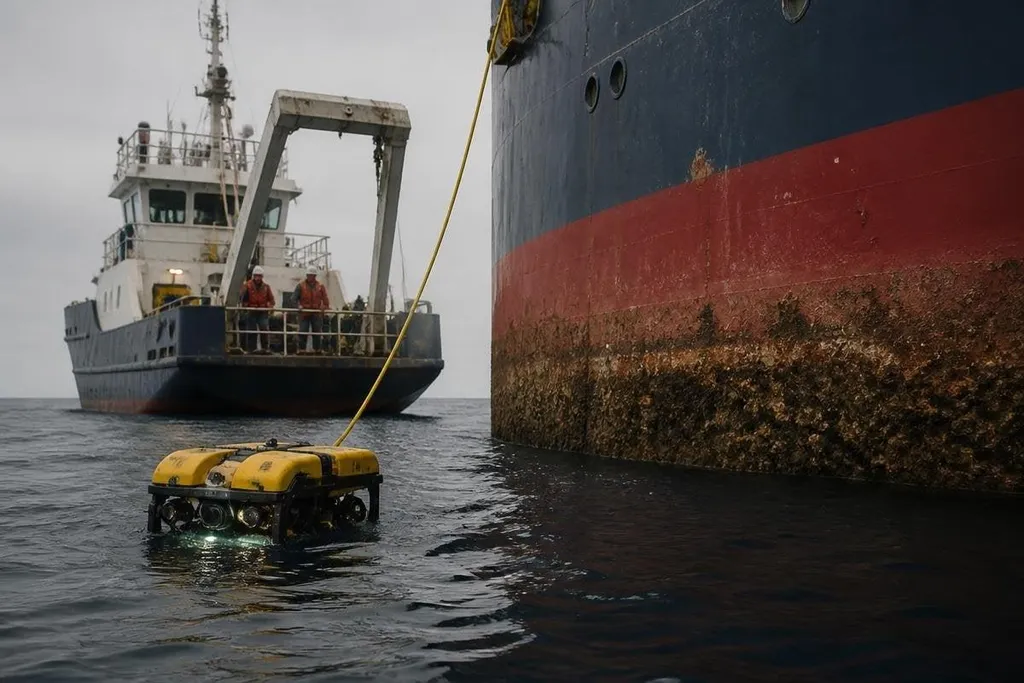
A marine robot can inspect a ship hull, map the seabed, or collect water data without putting a diver in the same place. That changes who faces the danger, but it doesn't remove the hard parts: saltwater, poor signals, limited power, and recovery.
- People stay farther from hazards: robots can inspect wrecks, pipelines, and deep water before a crew enters.
- Different robots fit different jobs: ROVs use a tether, AUVs follow planned routes, and USVs work on the surface.
- The weak point is often support: batteries, cables, data links, and recovery gear can decide whether a mission works.
What marine robots do well
The clearest benefit is safer inspection. A remotely operated vehicle, or ROV, can carry cameras, sonar, lights, and a manipulator arm into dark or deep water while an operator stays on a support vessel. The tether sends power and control signals between the vehicle and the surface.
That setup suits work where a person needs live video and direct control. An ROV can check a pipeline joint, inspect the underwater blades on a ship, or look at a damaged offshore structure while the operator reacts to what the camera shows.
Autonomous underwater vehicles, known as AUVs, work differently. They carry their own battery and follow a planned route using sensors such as sonar and inertial navigation. GPS signals do not travel far underwater, so an AUV cannot depend on a normal satellite position fix once it dives.
This makes AUVs useful for repeated survey work. They can collect seabed data along a set path, then return with records that a team can compare across different missions. The benefit comes from repeatable data, not from removing people from the job entirely.
Uncrewed surface vessels, or USVs, stay on the water. They can carry cameras, radar, sonar, and other sensors while moving across a survey area. A USV may also act as a communications link for underwater robots, though that adds another vehicle and another system that can fail.
A marine robot can lose its route when wind or a weak signal changes the job. Marine robotics reports from Robot24.com can tie each claim to the vessel, water conditions, task, test date, and result. That record leads into the risks below, where a sensor fault or lost link can stop the mission.
Where the risks start
Saltwater attacks exposed metal, connectors, seals, and electronics. A small leak can end a mission, while marine growth can cover a camera or add drag to a vehicle. Regular inspection and cleaning are part of the operating cost, even when the robot itself works as planned.
Communication creates a second limit. Radio signals work poorly underwater, so AUVs often store data and send it after they return to the surface. Acoustic links can reach through water, but they carry less data than a normal wireless network and can suffer from noise, reflections, and changing conditions.
Power sets another boundary. An AUV that spends too long searching for a target may not have enough battery to return. An ROV avoids that battery limit through its tether, but the cable can snag on structures, reduce the vehicle’s movement, or add work for the support crew.
A robot can also make a wrong choice with very little warning. Low visibility, strong currents, damaged sensors, and unfamiliar seabed shapes can confuse its control system.
A person watching the video may still need to take over, and that person needs a clear view of the robot’s position and condition.
I’d treat marine robots as tools that move risk and extend inspection, not as replacements for the crew and support plan.
Use the right robot for the job
The choice should start with the task, the water, and the recovery plan. A machine that works well in a calm harbor may be a poor fit for open water with strong current.
Use this check before choosing a system:
- Set the depth: confirm the robot, tether, seals, and sensors can work at the planned depth.
- Define the data: decide whether you need live video, stored sonar maps, samples, or physical manipulation.
- Plan the link: check where radio, acoustic, or tethered communication will work and where it will fail.
- Reserve recovery time: set out how the crew will find, lift, and secure the robot after the mission.
- Test the failure case: decide what happens after lost contact, low battery, a snagged tether, or a blocked sensor.
That last point deserves more attention than many buyers give it. A marine robot is part of a system that includes the vessel, operators, software, launch gear, maintenance work, and safety rules.
What happens next
Marine robots will keep taking on surveys and inspections where human access costs too much or creates too much danger. The next useful step is better proof from real deployments: mission records that show how often systems lose contact, need recovery, or require a human operator to take control.